Reshoring math fails more often than it succeeds, and not because labor is expensive. Companies that move production to the United States typically budget for the plant and the payroll, then discover that tooling, supplier ecosystems, permitting, and ramp-up yield each add costs that the sticker price never showed. The result is a pattern familiar from automotive and electronics relocations: announced savings shrink, timelines double, and the project still makes sense — just for different reasons than the deck promised.
What are the visible costs?
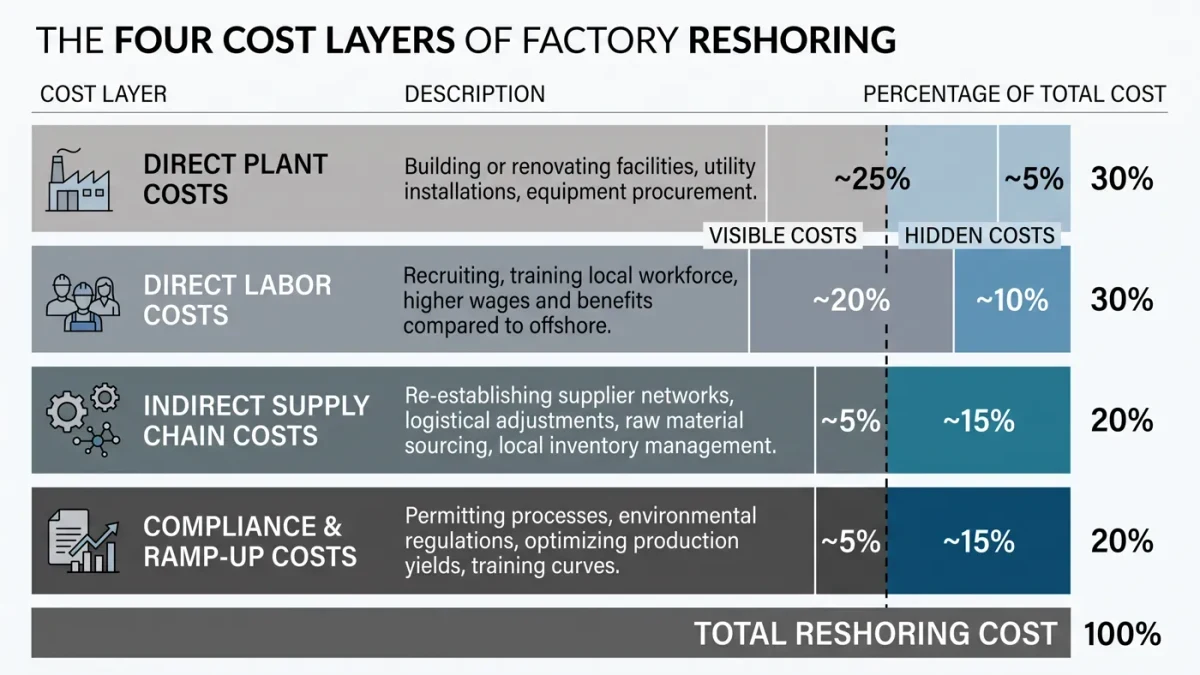
The visible layer is construction and equipment. A mid-size assembly plant runs from the low hundreds of millions into the billions once clean rooms, testing labs, and utilities are included; announced US semiconductor projects have listed price tags above $20 billion for leading-edge fabs, per company disclosures. Labor is visible too: US manufacturing wages run several times those in major Asian sourcing hubs, per Bureau of Labor Statistics compensation data. But visible costs are the easy part, because they arrive with invoices and end after startup.
Which hidden costs bite hardest?
Tooling and qualification come first. Molds, fixtures, and process documentation often belong to the incumbent overseas supplier or need to be rebuilt from scratch, and requalifying a part with a customer's engineers takes months. Second, the supplier ecosystem: a circuit board assembled in the US still sources laminates, connectors, and packaging globally, and each domestic switch multiplies logistics. Third, permitting and utilities — a plant that needs dedicated water, power, or rail faces queues measured in years in parts of the country, per state economic-development filings. Fourth, ramp yield: new plants start slow and scrap heavily, and the gap between design capacity and first-year output is a cost line most models omit.
How do incentives change the math?
Public money shifts the ledger. Federal chip and clean-energy credits, plus state packages of tax abatements, infrastructure spending, and training funds, routinely cover a meaningful share of project cost for qualifying industries. The Commerce Department's semiconductor program has tied awards to milestone completion, meaning money arrives after spending, not before. Incentives do not cover the operating-cost gap — they buy down capital. That distinction matters: a plant whose economics only work with permanent subsidies remains exposed to every appropriations cycle.
What do successful reshoring projects share?
Three traits recur. Automation first: the plants that work are designed around fewer, higher-skilled operators running automated lines, not around recreating labor-intensive assembly at US wages. Partial relocation: companies move the final assembly or the quality-sensitive step, not the whole chain, keeping tariff exposure and logistics manageable. And patient capital: owners who plan on a five-to-seven-year payback rather than an 18-month one. Cases that fit this shape — automated metal fabrication, packaging, printed circuit board assembly for defense-adjacent demand — have been the most durable movers in trade data since 2021.
How does a company decide honestly?
Landed-cost comparison is the start, not the answer. A defensible model prices total delivered cost over five years, including tariff scenarios at current rates and at zero — after the February 2026 Supreme Court ruling invalidated IEEPA tariffs, rate reversals are no longer hypothetical — plus inventory buffers for longer supply chains, dual-sourcing overhead, and the cost of the ramp. It also prices risk reduction as a benefit: shorter lead times, fewer port exposures, and eligibility for federal procurement that requires domestic content have dollar value even when the unit cost is higher.
News ABC publishes information, not investment advice; sourcing decisions belong to each company on its own numbers.
Is reshoring accelerating overall?
Construction spending on manufacturing facilities has run far above its historical trend since 2021, led by chips and batteries, per Census Bureau construction data. Announcements, however, outnumber completed projects, and completion schedules keep sliding. The honest read is that reshoring is real, concentrated in capital-intensive sectors, and slower than any press release suggests.