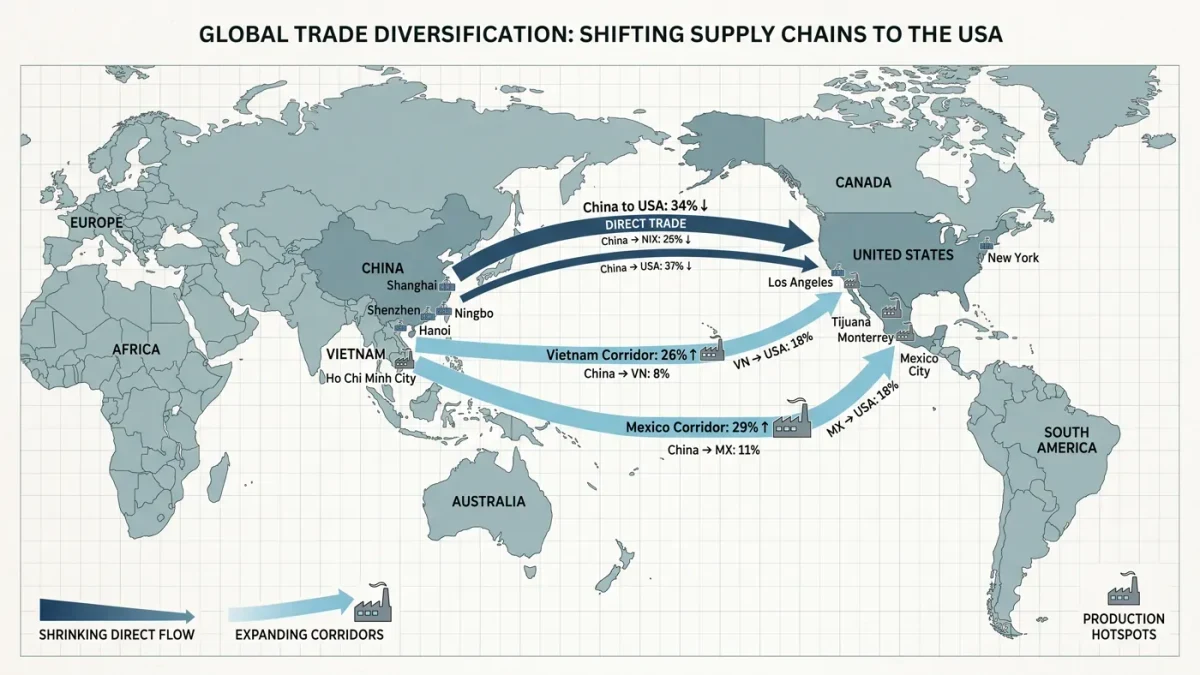
The great supply-chain relocation happened, just not the way the speeches described. Instead of production returning to the United States en masse, importers moved final assembly and sourcing one or two countries closer or friendlier: Mexico for vehicles, appliances, and machinery; Vietnam and India for electronics, furniture, and apparel. Trade data since 2018 show the shift clearly — China's share of US goods imports has fallen from its peak, while Mexico became the top US trading partner and Southeast Asian origins grew — but the deeper story is what did not change: the components, the machines, and much of the ownership structure stayed global.
What actually moved?
Assembly and finishing. A product that once shipped finished from China now often ships from Vietnam or Mexico — but trade data and product-level analyses show Chinese parts feeding those Vietnamese and Mexican factories. That is relocation of the last production step, not decoupling: China's exports to Mexico and Vietnam rose alongside its falling share of direct US imports. Economists call it the connector-country pattern, and it means tariff leakage — the same goods reaching US consumers through a third country with added value and a new origin label — is a feature of the system, not a bug in it.
Why Mexico and Vietnam specifically?
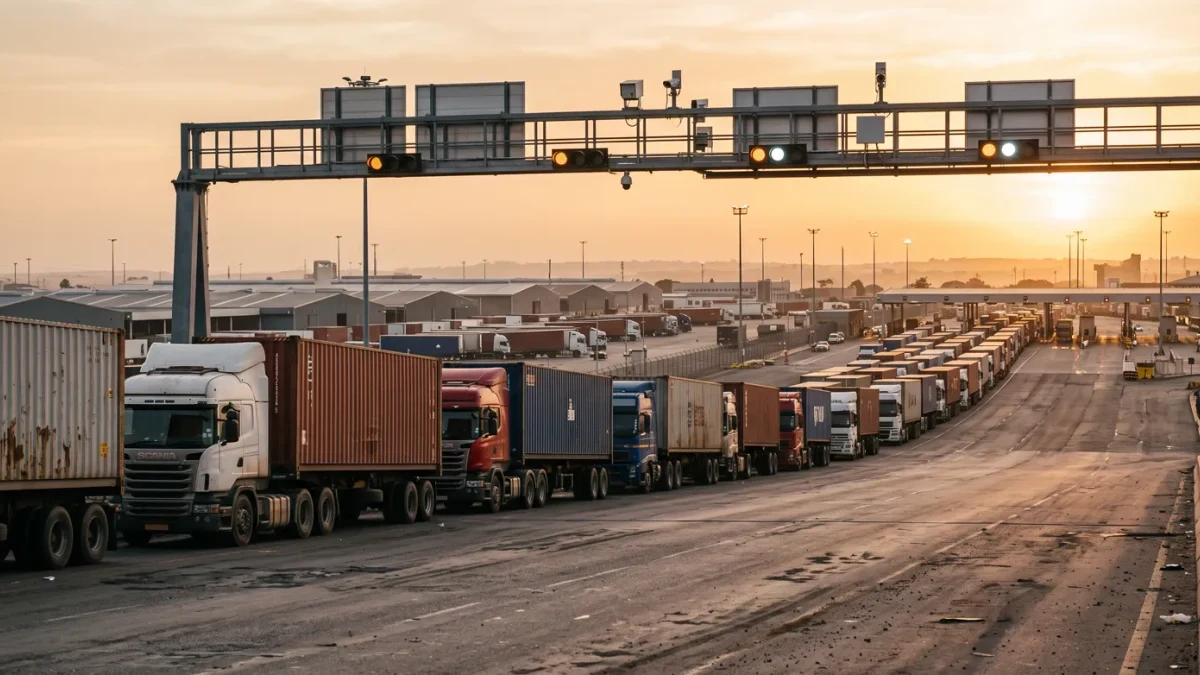
Geography and trade law. Mexico shares a land border and sits inside the USMCA framework, so tariff treatment for qualifying goods is preferential and transit is measured in hours by truck rather than weeks by ship — the reason automotive and appliance supply chains concentrate there, with the corridor's industrial parks expanding visibly in leasing data. Vietnam offers scale labor costs, an established electronics assembly base built during the trade war, and trade agreements covering major markets. Both benefited from companies' diversification mandates after pandemic shortages and tariff escalation: the phrase in corporate disclosures is China-plus-one, and the plus-one is usually one of these two.
What did nearshoring not fix?
Concentration risk upstream. Rare-earth processing, battery precursors, active pharmaceutical ingredients, printed circuit boards, and semiconductor packaging remain heavily concentrated in China regardless of where final assembly sits. A product assembled in Monterrey can still be stopped by a materials decision made in one Chinese industrial cluster. The policy conversation has shifted accordingly — from where goods are assembled to where inputs are refined — which is why critical-minerals agreements and friend-shoring language now dominate the industrial-policy documents that used to talk about finished goods.
What does USMCA review mean for this?
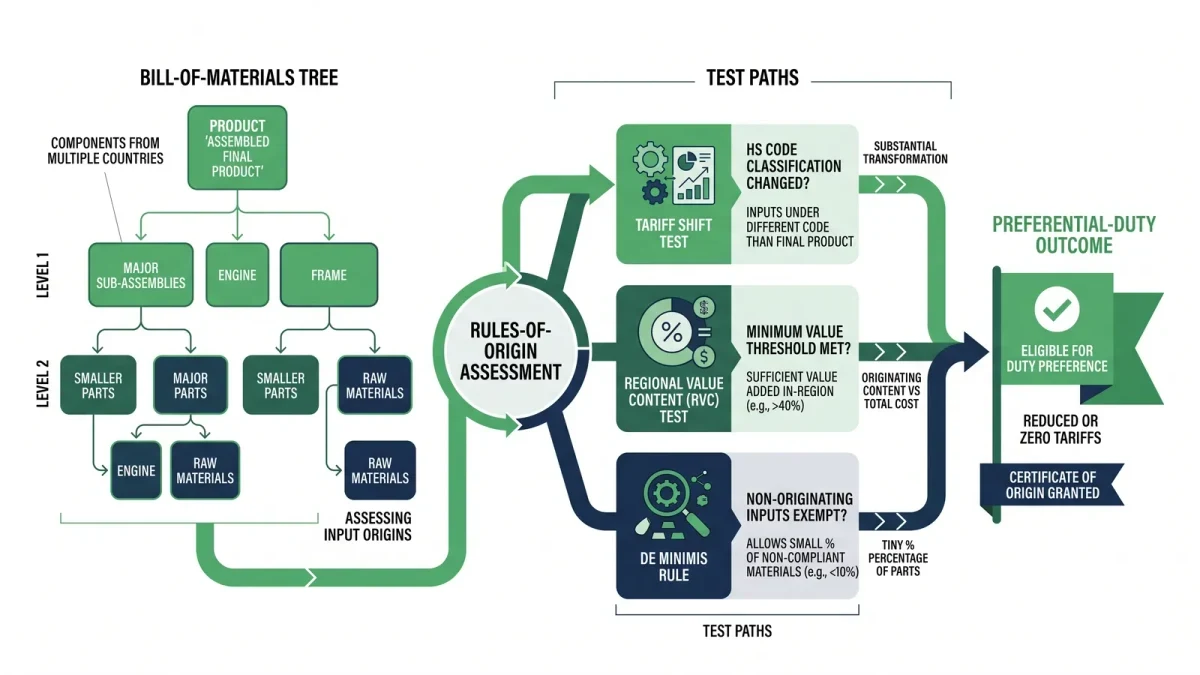
Risk, concentrated in rules of origin. US, Mexican, and Canadian negotiators opened a third round of bilateral USMCA discussions in July 2026, per trade-trackers following the process — and the leverage point is how much North American content a product must contain to qualify for preferential treatment. Tighter rules push more component production into North America; looser rules reward the assembly-relocation pattern. Companies with Mexican footprints are modeling both scenarios, and the review's outcome will effectively price the corridor against alternatives in Asia for a decade.
How should an importer act on this?
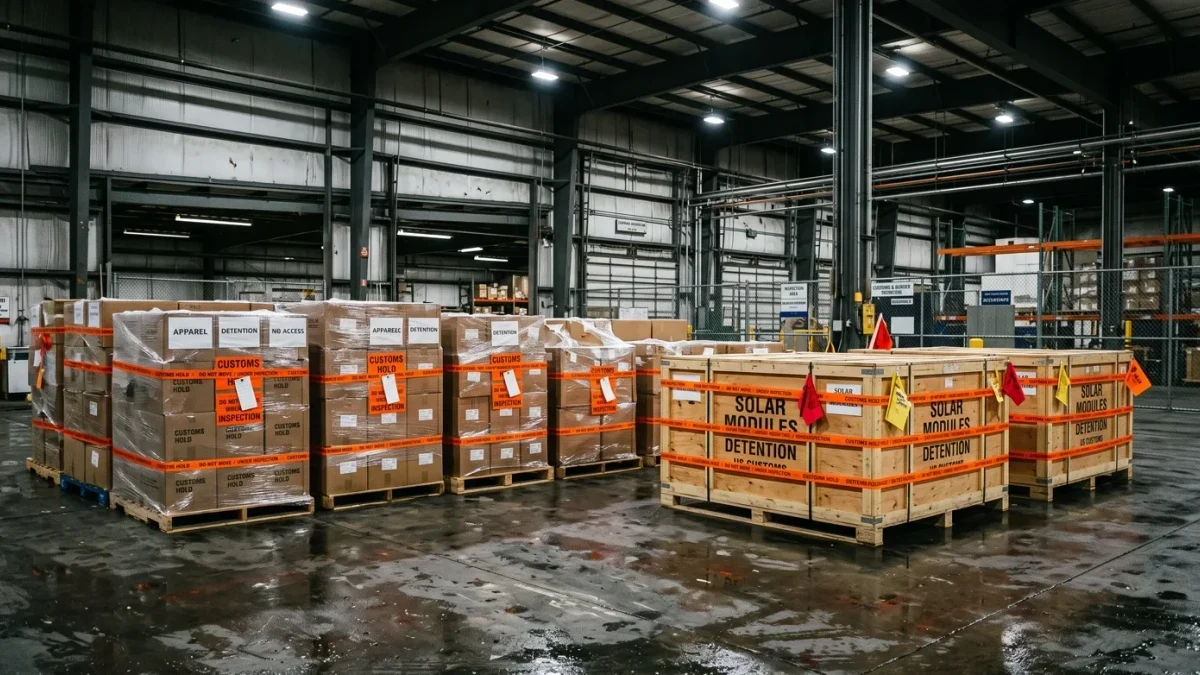
Map the bill of materials by origin, not by ship-from: the exposure is where the inputs are made, and that is the map to diversify. Qualify products under trade-agreement rules with documentation before claiming preferences — origin fraud is enforcement's current favorite. Accept that dual sourcing costs money and carries it as an insurance line, because the companies that navigated 2020-2026 best were the ones that paid for redundancy before they needed it. And watch rules-of-origin negotiations closely: a supply chain built on preferential access is a supply chain built on politics, which is exactly as stable as it sounds.