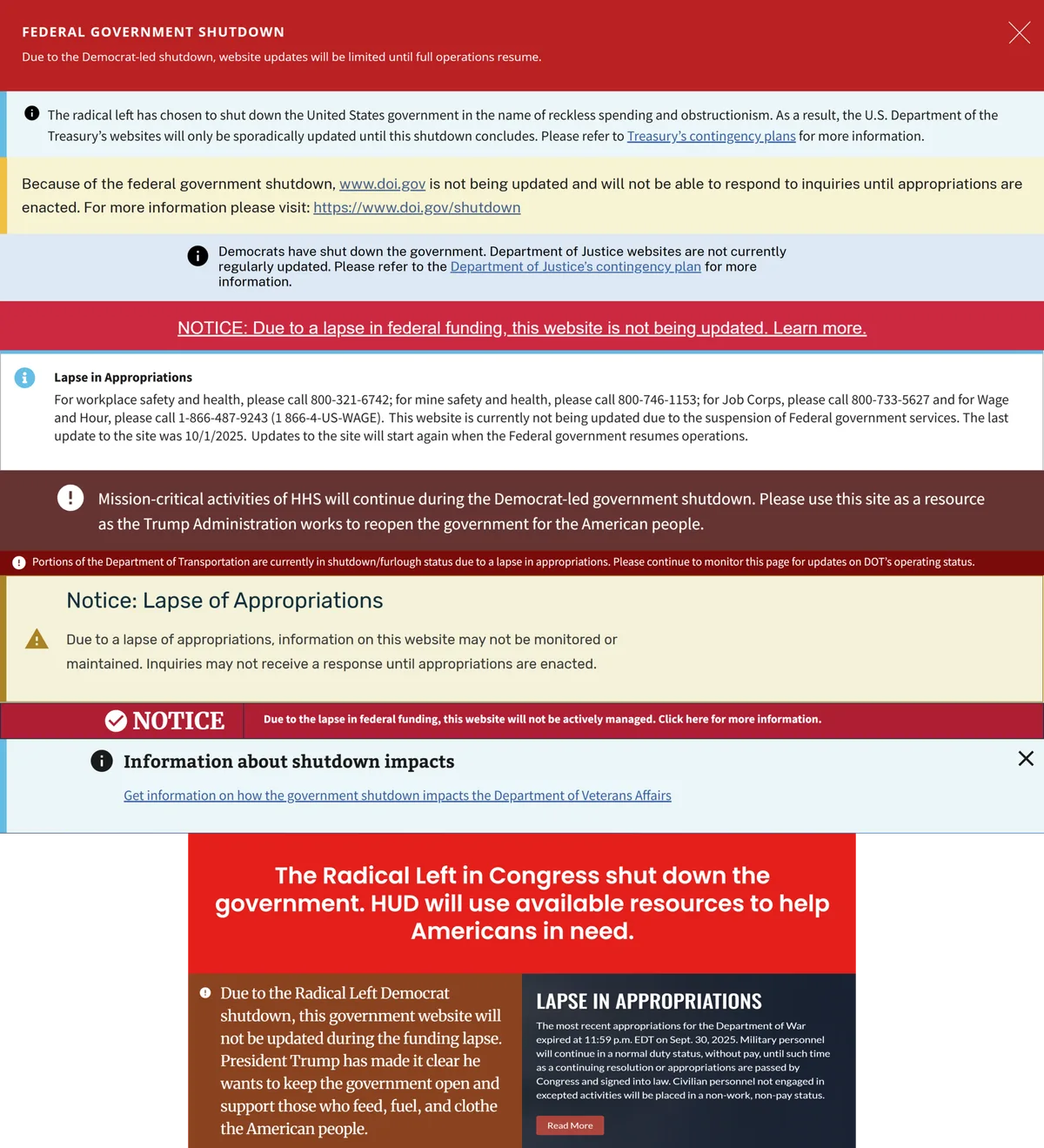
A government shutdown is a blindfold applied to the entire data infrastructure. When appropriations lapse, the agencies that publish the employment report, the CPI, GDP, trade figures, and the Federal Register notices that carry tariff proclamations operate under antideficiency rules that send non-emergency staff home and suspend the release calendar. The 2018-2019 shutdown, at 35 days the longest, demonstrated the mechanics fully: the employment situation for a month went unpublished, economic data series arrived late and patchy, and private analysts rebuilt shadow estimates from alternative sources. In an economy where policy moves by data-dependent central bank and tariff-calendar, a data blackout is not an inconvenience — it is an operational risk.
What actually stops?
Statistical agencies classify staff and functions as essential or not, and data collection and publication mostly fall on the non-essential side — the Bureau of Labor Statistics' field collection, the Census Bureau's surveys, the Bureau of Economic Analysis's estimation cycle. Releases are postponed, not merely delayed a day: the estimation work that produces them stops with the staffing, so the restart queue compresses publication schedules weeks after funding returns. Some functions continue by necessity — the Bureau of Labor Statistics has carried key inflation series through past lapses under specific procedures — but the default is suspension, and every lapse produces its own list of what survived and what waited.
Why the cost compounds
Because the data system is a network, not a list. Each release feeds others: the CPI enters inflation-indexed calculations and contract escalators; the employment report sets market expectations the Federal Reserve reads; trade statistics anchor tariff-policy evaluation and the quarterly GDP arithmetic. Miss one link and the downstream series lose their inputs — the BEA cannot compute what Census did not collect. Response rates suffer too: survey households and businesses that miss their collection window are lost observations, degrading the samples for the affected months in ways revisions never fully repair. The statistical damage outlasts the shutdown by quarters.
Who fills the gap?
Private substitutes, imperfectly. Payroll processors publish their own employment counts — real, timely, but covering their client firms rather than the economy. Credit and transaction data firms estimate retail activity. Forecasters rebuild GDP nowcasts from what survives. The substitutes proved their value in 2018-2019 and again in later lapses, and the market infrastructure now treats them as the bridge — but none carries the statistical guarantee of a probability sample with a published methodology, and the divergence between private and official estimates during a gap is itself a measurement problem: policymakers making decisions on shadow data cannot quantify the shadow's error.
The tariff-era version of the risk
Sharpened, because policy runs on these statistics now. Tariff evaluation needs the trade and price series that a lapse suspends; the Federal Reserve's rate path reads the employment and inflation releases the blindfold removes; and the administrative machinery — Federal Register publication, exclusion processing, protest adjudication at the trade agencies — slows with the staffing. A funding lapse in the current environment does not just pause information; it pauses the processes by which tariff policy is implemented and contested, stacking judicial and administrative deadlines onto a calendar the reopening must then digest.
What should readers watch?
The appropriations calendar itself — continuing resolutions and their expiration dates are the shutdown clock. The agencies' contingency plans, published in advance, which list precisely which releases survive a lapse — the honest preview of any blackout. And the restart queue after funding returns, because the compressed publication schedule is when missed data lands all at once and markets must digest months of economy in a week. The lesson of every shutdown is the same: the economy does not stop when the measurement does, but the understanding of it does — and a country that steers by data should notice when the instruments go dark.