Trade policy is personnel. The statutes authorize the machinery, but the officials the Senate confirms — the Trade Representative, the Commerce Secretary and the assistant secretaries who run enforcement, the Customs commissioner, the Treasury officials who police sanctions — set its speed, priorities, and temperament. A tariff on paper and a tariff administered are different things, and the difference is the appointee: how quickly investigations initiate, how exclusions are processed, how enforcement is aimed. The confirmation process is therefore trade politics in its most concentrated form.
Which positions matter most?
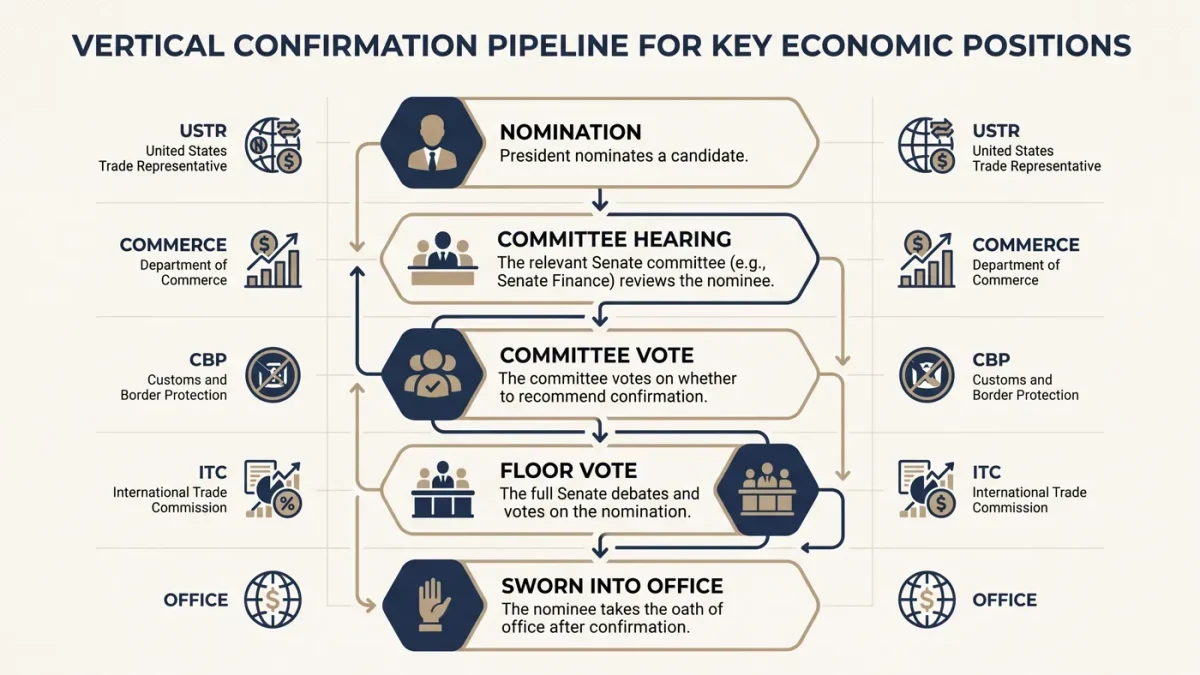
Four clusters. The US Trade Representative — the cabinet-level officer who runs Section 301 investigations, negotiates agreements, and litigates at the WTO; Senate Finance Committee jurisdiction, and the deputy and general counsel beneath. Commerce — the secretary plus the assistant secretary for enforcement and compliance, who runs antidumping and countervailing cases, and the Bureau of Industry and Security chief, who controls export licensing. Customs and Border Protection — the commissioner who sets entry-processing priorities, forced-labor enforcement, and port operations. And the International Trade Commission — six commissioners with staggered terms who vote on injury determinations, the fulcrum every trade-remedy case turns on.
How does the confirmation process actually run?
Nomination, then committee: Finance for USTR, Commerce for the commerce suite, Homeland Security and Finance for CBP. The hearings are where trade positions become public record — nominees are asked to state positions on specific tariffs, specific countries, and specific statutes, and their answers bind like few campaign statements do, because they are delivered under oath with a confirmation hanging on them. Holds and delays are leverage: a single senator's hold can leave an assistant-secretary post vacant for months, and trade vacancies have a direct cost — dockets slow, exclusion processing lengthens, negotiations stall. The ITC's staggered terms produce a subtler politics: the commission's composition at any moment reflects appointments made across two or three administrations, which is why injury determinations carry a texture no single president fully controls.
Why vacancies are policy
Because the machinery degrades politely. Without a confirmed enforcement chief, interim leadership proceeds cautiously — investigations initiate slower, adverse-facts-available decisions get reviewed harder, and petitioners notice. Without a full ITC bench — the six-member design requires quorum — the commission cannot act, and the trade-remedy pipeline itself stops; the commission has operated short-handed in past periods, delaying votes by months, which for a petitioning industry is the difference between relief and closure. Confirmed officials also carry the statutory independence that lets them say no: an ITC that finds no injury against a protected industry's petition is exercising exactly the judgment the confirmation process is designed to test.
What should a trade watcher track?
The nomination calendar alongside the docket calendar — an enforcement-and-compliance nominee with a petition-side background signals an aggressive antidumping posture; an export-control nominee from industry signals a licensing temperament. Hearing testimony for stated positions on the live statutes — post-February 2026, every nominee now gets asked where tariff authority should live. And the vacancy list itself: the Senate's own published list of pending nominations is the honest scoreboard of trade-policy throughput, because the gap between the statutes passed and the officials confirmed is where implementation goes to wait.
The durable point
Confirmation is where trade policy becomes accountable. Statutes delegate to offices, and the Senate's check on the offices is the last vote any of these powers receive — the February 2026 ruling on emergency authority makes that architecture newly relevant, as the debate shifts from what presidents may do under old statutes to what Congress writes in new ones, and who the Senate puts in place to run them. The machinery is statutes plus people. The people get a hearing.