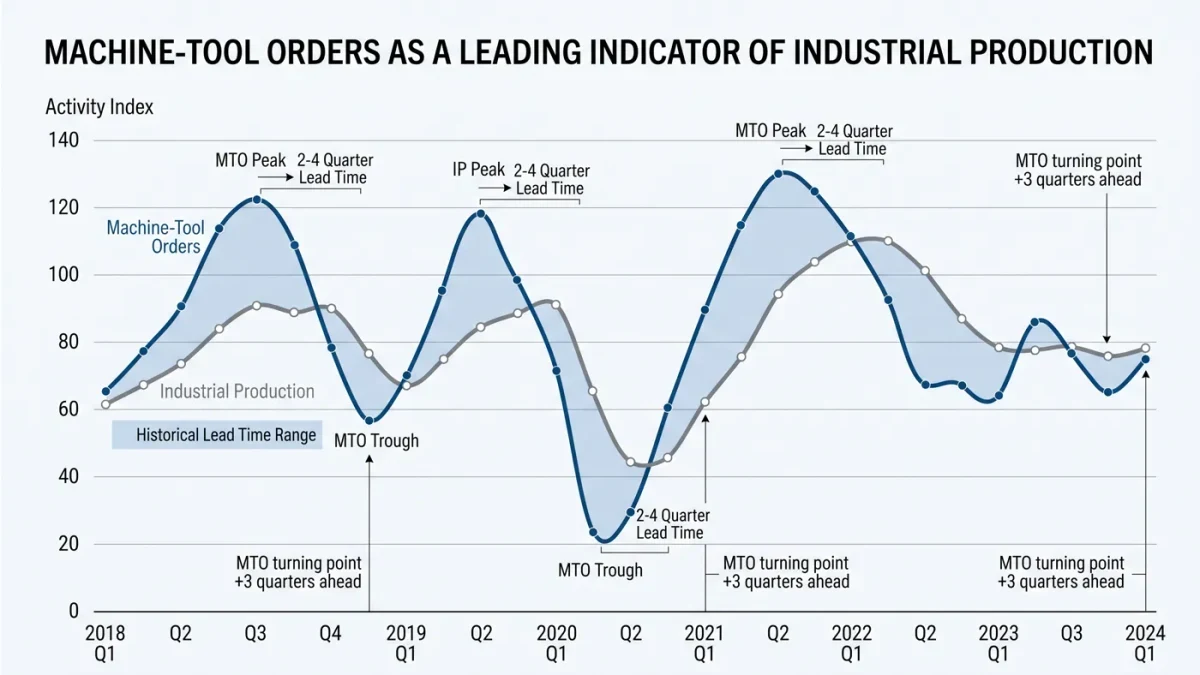
Machine tool orders are manufacturing's early-warning system. A shop that buys a machining center or a press today has committed capital to work it expects in six to eighteen months, which is why economists treat equipment orders as a forward read on industrial output. The United States' reference series — compiled from distributor-reported sales by an industry association — rises and falls ahead of factory production with fair regularity, and its monthly releases get parsed less than they deserve.
What is counted as a machine tool order?
The category covers metal-cutting and metal-forming equipment: machining centers, turning machines, grinding, stamping presses, laser and waterjet systems, and the accessory tooling sold alongside. Orders are reported by technology and by region, and the industry association that tracks them, working with a standards body, publishes monthly order values plus a twelve-month rolling total that smooths the lumpiness of big aerospace and automotive contracts. One jumbo order for an aircraft plant can lift a single month, which is why the rolling total is the number to watch.
Why do orders lead output?
Timing. Equipment is quoted, financed, built, installed, debugged, and staffed before the first production part ships. A shop orders when its backlog and quoting activity justify the spend, so the order book reflects what customers were asking for a quarter ago and expect to keep asking for. The lag to measured output is typically two to four quarters. The same logic makes cancellations informative: when shops let quoted orders lapse rather than confirming them, demand has softened before any official production statistic shows it.
How do tariffs and rates move the series?
Equipment is trade-exposed. Machine tools are heavily imported from Japan and Germany, and US tariffs on imported machinery raise shop-floor capital costs directly — a dynamic firms weighed through the tariff escalations of 2025 and the legal turbulence that followed, including the February 2026 Supreme Court decision invalidating IEEPA tariffs and the June 2026 restructuring of metals tariffs under Proclamation 11032, which changed the cost basis for both machines and the materials they cut. Interest rates work on the financing side: most equipment is leased or loan-funded, so each rate move shifts the monthly payment on the identical machine. Tariff uncertainty has a third effect — it delays decisions, which shows up not as falling orders but as a widening gap between quotes issued and orders confirmed.
How should a reader use the data?
Pair the rolling twelve-month order total with three companions: core capital-goods orders from the Census Bureau's durable-goods report, which covers a broader equipment basket; the manufacturing workweek from the jobs report, which shows current intensity; and the ISM new-orders index, which captures sentiment. When machine-tool orders and core capex rise together while the workweek is flat, capacity is being built for demand not yet visible in production — typically mid-cycle. When orders fall but the workweek holds, shops are sweating existing assets — late-cycle or a pause. The series' weakness is concentration: a handful of industries drive it, so a single aerospace program or vehicle platform refresh can masquerade as a trend. Regional splits help separate a genuine upturn from one customer's launch.
What is the long-run signal?
Order values have climbed over decades even as employment fell, marking the sector's shift toward automation: fewer operators, more capital per worker. A sustained rise in orders without a matching rise in employment is not weakness — it is the definition of productivity investment. Policymakers read it the same way: equipment demand is the private-sector vote on whether the industrial base is expanding, and it is a vote cast with money rather than surveys.