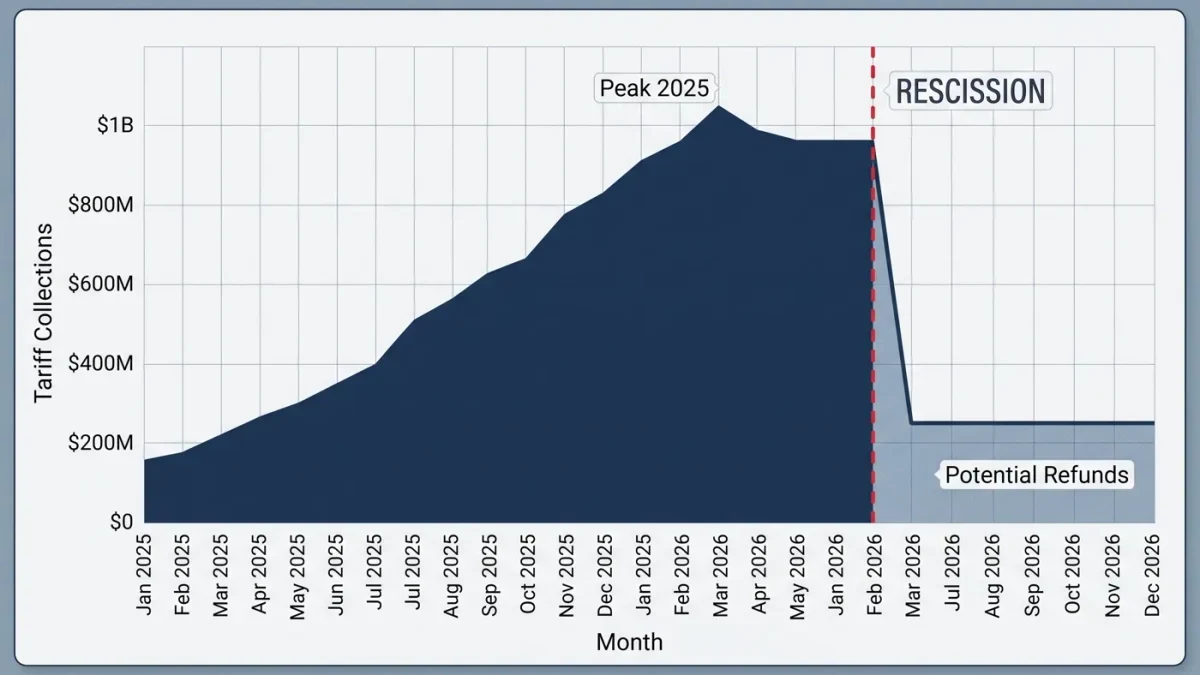
The federal government is collecting less tariff revenue in 2026, and the reason is a courtroom, not a negotiation. After the Supreme Court ruled 6-3 in February 2026 that the International Emergency Economic Powers Act does not authorize tariffs, the IEEPA tariffs were rescinded as of February 7, 2026 — and with them the largest single block of 2025's customs collections, per the Congressional Research Service's summary of the ruling. Duties collected under the invalidated authority now sit in legal limbo, with Penn Wharton Budget Model projections putting potential refunds at up to $175 billion.
What replaced the lost revenue
A smaller, statute-based architecture. Section 232 metals tariffs continued and were restructured through 2026 — the April restructuring, the June framework under Proclamation 11032, and the July adjustments that cut certain rates from 25% to 15%. Section 301 actions added duties of 10% and 12.5% on targeted lists. The net direction is nonetheless lower: the baseline emergency tariffs that produced much of 2025's collections are gone, and their statutory substitutes cover narrower product sets at lower rates, per analyses of the ruling's fiscal implications, including Penn Wharton's projection that tariff revenue falls significantly absent replacement.
The refund problem
Duties paid under invalidated authority are the unusual fiscal artifact: money collected under color of law that no longer exists. The Court explicitly declined to rule on repayment, leaving importers to pursue refunds through the Court of International Trade and the protest process — hence the $175 billion estimate and the certainty of years of litigation over who qualifies, in what order, and with what interest. Customs processing of refund claims, as with the collections themselves, runs through entries and bonds; importers with documentation stand first in line, a quiet advertisement for the file-keeping the compliance function preaches.
Why it matters beyond Washington
Because the revenue line had become budget-relevant: 2025's collections at annualized levels rivaled major program outlays, and budget planning leaned on them. The ruling converts that planning assumption into a litigation schedule. Watch three indicators now: monthly customs deposits in Treasury statements, which will show the post-rescission baseline; the refund-litigation docket at the trade court; and any legislative move to ratify or replace portions of the rescinded tariffs — the one route that could restore revenue without touching the constitutional question the Court decided.