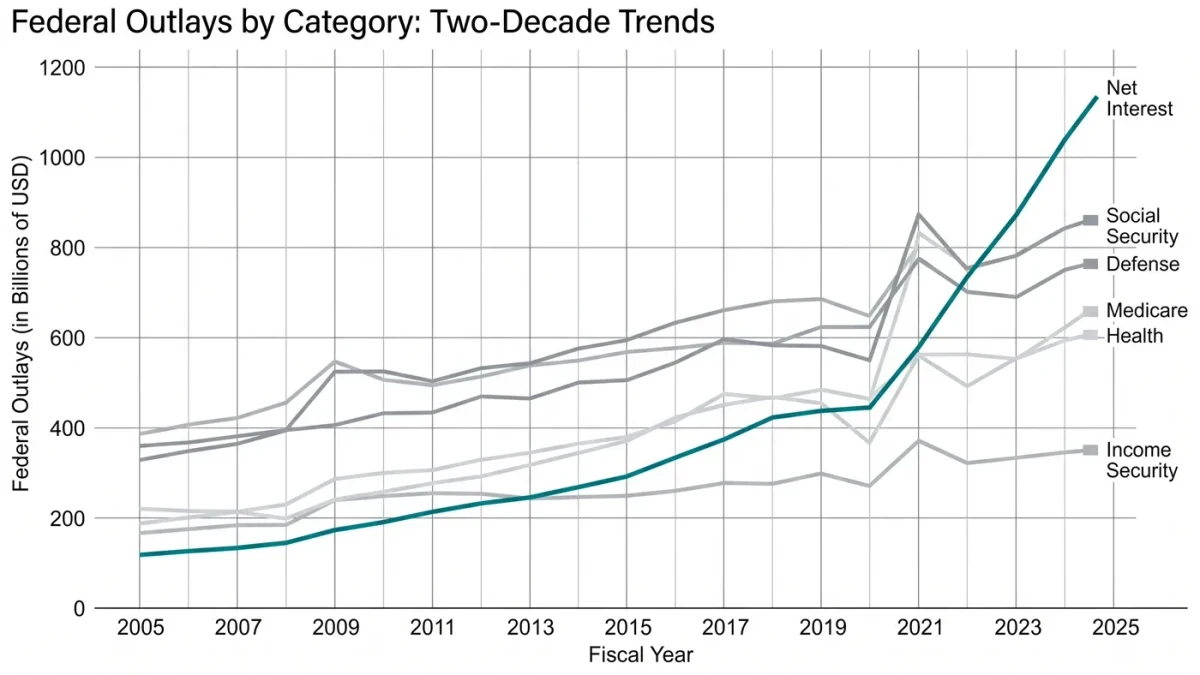
The fastest-growing major item in the federal budget is not defense, Social Security, or any program anyone votes on — it is interest on the debt. Net interest outlays crossed a trillion dollars on an annual basis as the stock of Treasury securities rolled into higher rates, per Treasury and Congressional Budget Office data, making interest a top-tier budget category on its own. It is the line item that grows without appropriation, and its arithmetic narrows every other fiscal decision.
How did the cost get here?
Two multipliers: more debt and higher rates. Debt held by public rose through pandemic-era deficits and continued climbing as deficits persisted at levels well above the historical share of GDP, per CBO's baseline documents. Meanwhile, the average interest rate on outstanding debt reset upward as maturing securities rolled from the low-yield era into the post-2022 rate environment. The average maturity of US debt is roughly six years, which means the repricing is slow — a Treasury issued at 1% in 2021 refinances at market rates only when it matures. The bill for the rate-hiking cycle therefore arrives on a lag measured in years, and it is still arriving.
Why does this constrain policy?
Because interest is effectively mandatory spending — it cannot be cut by appropriations, only by refinancing, surpluses, or inflation. Every dollar of interest is a dollar unavailable for anything discretionary, and in the CBO's projections interest grows faster than revenue under current law, absorbing an increasing share of GDP. The policy consequence arrives through the bond market: sustained deficit projections at these levels require the Treasury to issue steadily, and buyers demand yields that compensate for the supply — the term-premium channel that also showed up as curve distortions in 2025-2026. Fiscal debates that ignore the interest line are debating the smaller half of the budget.
Who actually pays this interest?
Mostly domestic holders and the government itself. The Federal Reserve's holdings pay interest that remits back to Treasury; Social Security and other trust funds hold intragovernmental debt; households, money-market funds, insurers, banks, and foreign central banks hold the rest. Interest payments are thus a large domestic transfer — a trillion-dollar annual flow from taxpayers to bondholders, with distributional consequences that depend on who owns the bonds. The foreign-share framing that dominates commentary describes a minority of the stock, and the share has been stable for years.
Can the trajectory change?
Three forces can bend it, each with a catch. Rates: the December 2025 Fed cut to 3.50%-3.75% and any further easing slow the repricing — but the average maturity lag means cuts take years to fully reach the debt stock. Growth: faster nominal GDP shrinks the debt-to-GDP ratio mechanically — but the deficit path, not growth, dominates the projection. Policy: primary-balance reforms change the debt path itself — the catch being the political economy of the necessary size. What does not work: defaulting on the obligation, which is not an option in a system where Treasury securities are the world's collateral base, and inflating it away quietly, which the maturity structure and indexed securities limit.
What should a reader watch?
The Treasury's quarterly refunding statements for issuance mix; the interest-to-revenue ratio, which measures the squeeze directly — double digits and rising is the historical warning zone; and CBO's annual long-term outlook for the trajectory. The number to hold in mind is simple: at a trillion dollars and climbing, interest now costs more than most of the departments and programs the budget fights are fought over. The quiet line item has become the loudest constraint in the room.