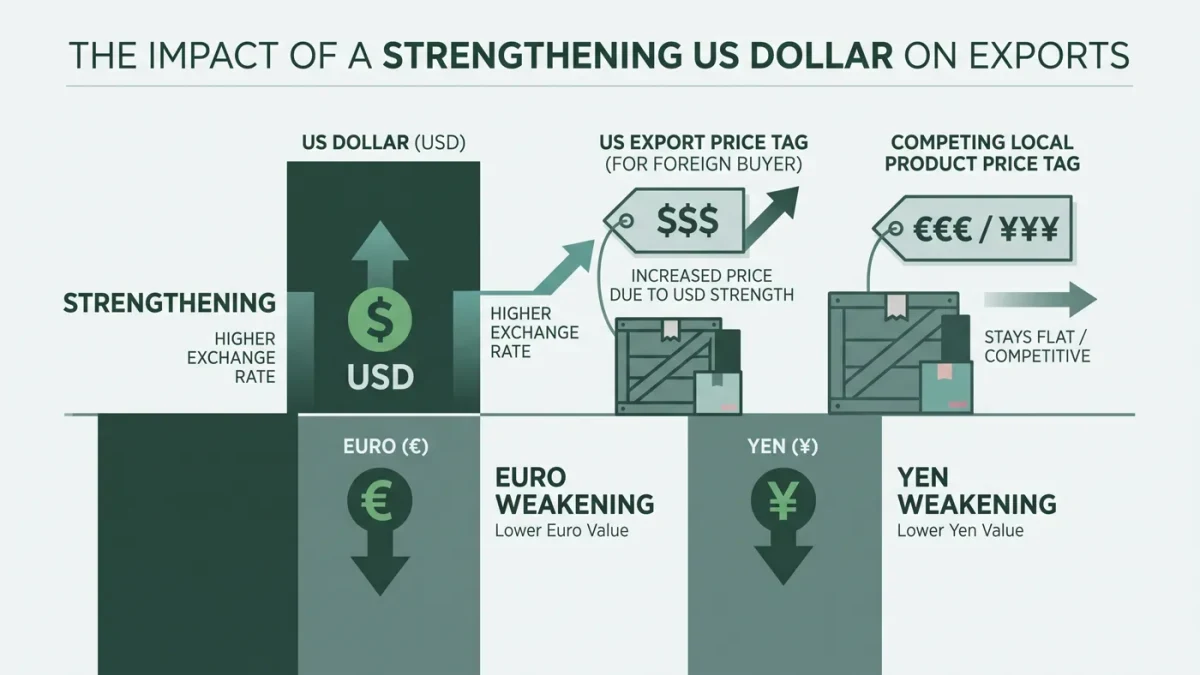
Currency is the tariff policy nobody announces. When the dollar strengthens, every US exporter's prices rise in the buyer's currency overnight — no proclamation, no docket, no comment period — and the competitive effect is the same as a tariff applied to American goods. For small manufacturers, who lack the hedging desks and multinational footprints that let large firms manage currency, a strong dollar cycle is a margin event measured in export orders.
How the mechanism works
A US firm that prices in dollars hands the currency risk to its customer: when the dollar gains 10% against the euro, the European buyer's cost rises 10% unless the US firm cuts its dollar price — eating its own margin — or the buyer switches to a European supplier whose price never moved. Firms that price in the buyer's currency take the hit directly on conversion. Either way, the arithmetic lands: a stronger dollar raises the relative price of US goods, and export volumes respond with the lag contracts impose. The classic estimate from trade economics: a 10% dollar appreciation dents US manufacturing exports measurably over the following two years — the elasticity that made dollar policy a standing industrial-policy debate.
Why small exporters are exposed hardest
Scale, again. Large multinationals hedge currency with derivatives programs, produce in local markets, and invoice strategically across currencies; a small shop with one product line and a handful of foreign accounts has a spreadsheet and a bank that will sell it forwards at prices sized for bigger clients. Their foreign buyers are also smaller and more price-sensitive — the buyer who switches suppliers over a currency move is a mid-size firm abroad, not a global procurement office with switching costs of its own. And small exporters' contracts are typically shorter, which cuts both ways: the pain arrives faster, and so would the relief.
What can a small exporter actually do?
The working toolkit, from trade-finance practice. Price currency in: quote in the buyer's currency with the margin cushion sized for the hedging cost, and hedge the exposure with bank forwards — imperfect for small tickets, but improvable by netting quarterly rather than per order. Match costs to revenues: sourcing components in the same currency as sales — the natural hedge that European exporters use structurally. Share the risk contractually: currency-adjustment clauses that reprice bands when rates move beyond thresholds keep relationships alive through swings. Use the official tools: the Export-Import Bank's working-capital and export-credit programs exist for exactly this gap, and small firms underuse them. And hold the price where the product earns it: exporters with genuinely differentiated products hold dollar prices and keep volume; commodity-grade sellers do not, which is the uncomfortable sorting a strong dollar performs.
What is the current configuration?
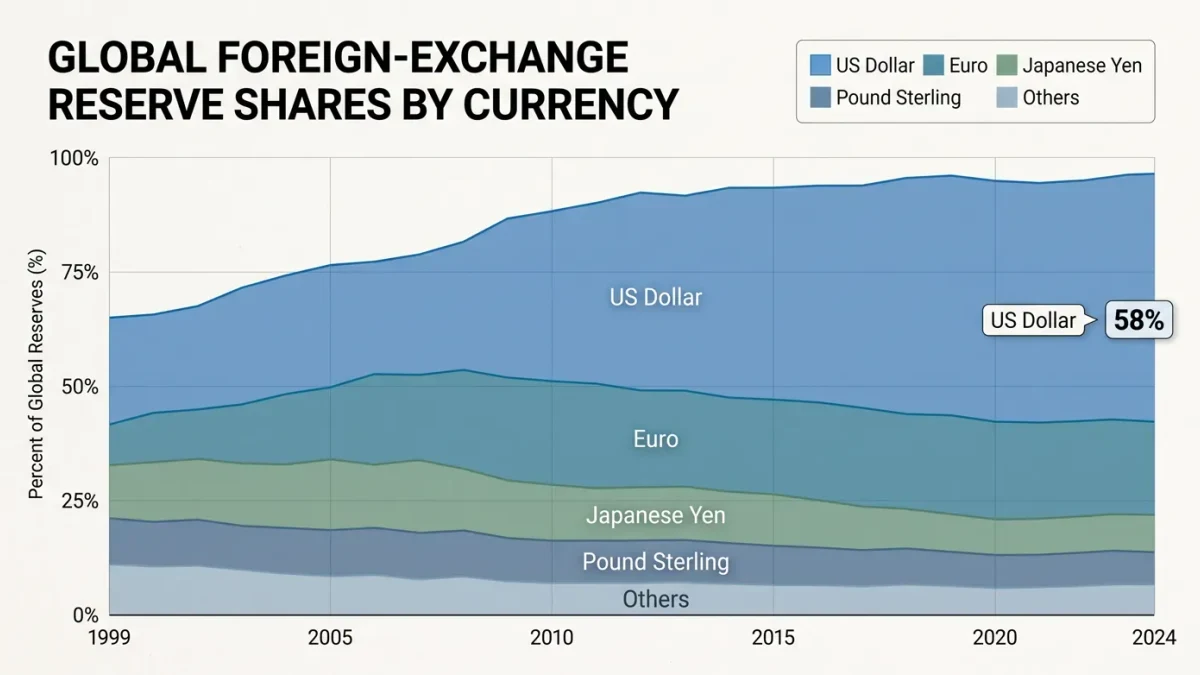
Mixed, and policy-dependent. The dollar's swings through 2025-2026 tracked the tariff and rate sequence — trade-policy news and Federal Reserve expectations moved it in both directions, with the December 2025 cut to 3.50%-3.75% part of the rate path currencies repriced. The structural supports for dollar strength persist — Treasury market depth, the reserve role — while the fiscal and tariff cycles argue episodically the other way. For planning purposes a small exporter should treat the exchange rate as the one price it neither sets nor sees coming, and organize accordingly.
The honest summary
A strong dollar is not a moral fact or a market verdict; it is a price with consequences, and the consequences concentrate on the firms with the least financial engineering available. The exporters who survive strong-dollar cycles are the ones who priced the risk before it arrived — currency-aware contracts, matched costs, hedged tranches — rather than discovering, at the quarter's conversion, that their best customer just bought elsewhere. The invoice is where monetary policy meets the machine shop. Someone should tell the machine shop before the invoice does.
News ABC publishes information, not financial advice.