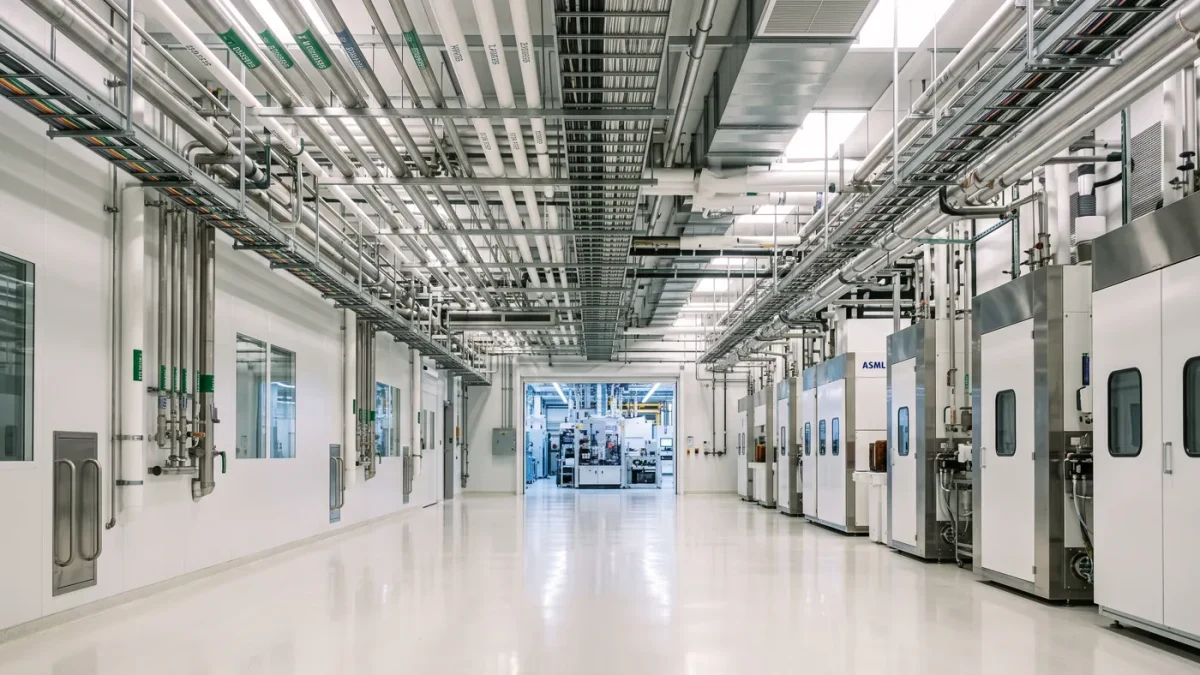
The hardest part of building a US chip plant is not the lithography — it is the water, the power, and the pipes. An advanced fabrication plant uses millions of gallons of ultrapure water a day and draws electricity on the scale of a small city, and it needs both without interruption, because a voltage sag of milliseconds can scrap a production batch worth millions. As multibillion-dollar fab projects spread beyond traditional semiconductor clusters, the binding constraint has shifted from construction crews to infrastructure.
How much water does a fab actually use?
A large leading-edge fab can consume on the order of two to four million gallons of water per day, per environmental disclosures from operating sites in Arizona and Taiwan. Most of it becomes ultrapure water that rinses wafers between process steps; the purification itself wastes a share of the intake unless reclamation systems recapture it. Modern sites reclaim a substantial majority of their process water, and reclamation rates are now a headline figure in expansion announcements, because a plant that recycles 85% still needs a daily intake that can stress a mid-size city's supply in a drought year. Water permits, not clean-room schedules, increasingly set startup dates in the American Southwest.
Why is the power requirement so strict?
Fabs run 24/7, and the tolerance for interruption is near zero. Leading sites arrange dual utility feeds plus on-site backup generation, and utility interconnection queues — the waiting lines for new high-capacity grid connections — can run years, per grid-operator filings. Peak demand for a gigascale campus is measured in hundreds of megawatts, comparable to a mid-sized municipal utility's entire load. That is why fab announcements arrive with substation plans attached, and why some operators sign direct power-purchase agreements with renewable and nuclear suppliers to lock supply for decades. Copper tariffs add a footnote: grid and plant wiring is copper-intensive, and Section 232 brought copper imports under tariff administration in 2026, nudging infrastructure input costs at the margin.
What happens to the water after it rinses wafers?
It leaves loaded with what the process added. Fab wastewater carries acids, solvents, and dissolved solids, and treatment to discharge standards is a permanent operating cost and permitting conversation. Communities near new US sites have raised effluent and intake questions at public comment periods, and regulators require discharge permits separate from intake permits. The industry's answer — closed-loop reclamation and per-wafer consumption targets published in corporate responsibility reports — is genuine but partial: recycling slows the growth of demand, it does not eliminate it.
Why do fabs cluster anyway?
Because infrastructure compounds. A region that already has ultrapure-water expertise, high-voltage capacity, chemical-supplier logistics, and a trained technician pool lowers every one of these constraints at once — which is why Texas, Arizona, and upstate New York keep landing projects while shovel-ready sites elsewhere wait for the utility studies. Clustering also concentrates the risk: a drought or grid event in one region now touches a large share of national capacity, a supply-chain lesson buyers of chips learned the hard way during pandemic-era shortages.
What should local officials and suppliers take from this?
For officials: the competition for fabs is won or lost on interconnection timelines, water rights, and permitted wastewater capacity, and the sites that publish those facts up front attract faster commitments. For suppliers: every fab is an anchor customer for water treatment, power quality equipment, industrial gases, and precision piping, and the build-out of US capacity has created a domestic market for that ecosystem that did not exist at scale a decade ago. For chip buyers, the lesson is capacity diversification — the water-and-power map of the United States is effectively the risk map of the chip supply chain.
News ABC publishes information, not procurement advice.