Supplier diversification is insurance, and insurance has premiums. Since the tariff escalations and pandemic aftershocks, virtually every importer with China exposure has announced a China-plus-one strategy — qualifying a second source in Vietnam, India, Mexico, or elsewhere. The announcements are cheap. The qualification is not: tooling duplication, quality validation, logistics setup, and the permanent overhead of running two supply lines for volume one could carry. The firms that succeeded treated those costs as a line item; the ones that struggled treated diversification as a press release with a purchasing memo attached.
What qualification actually costs
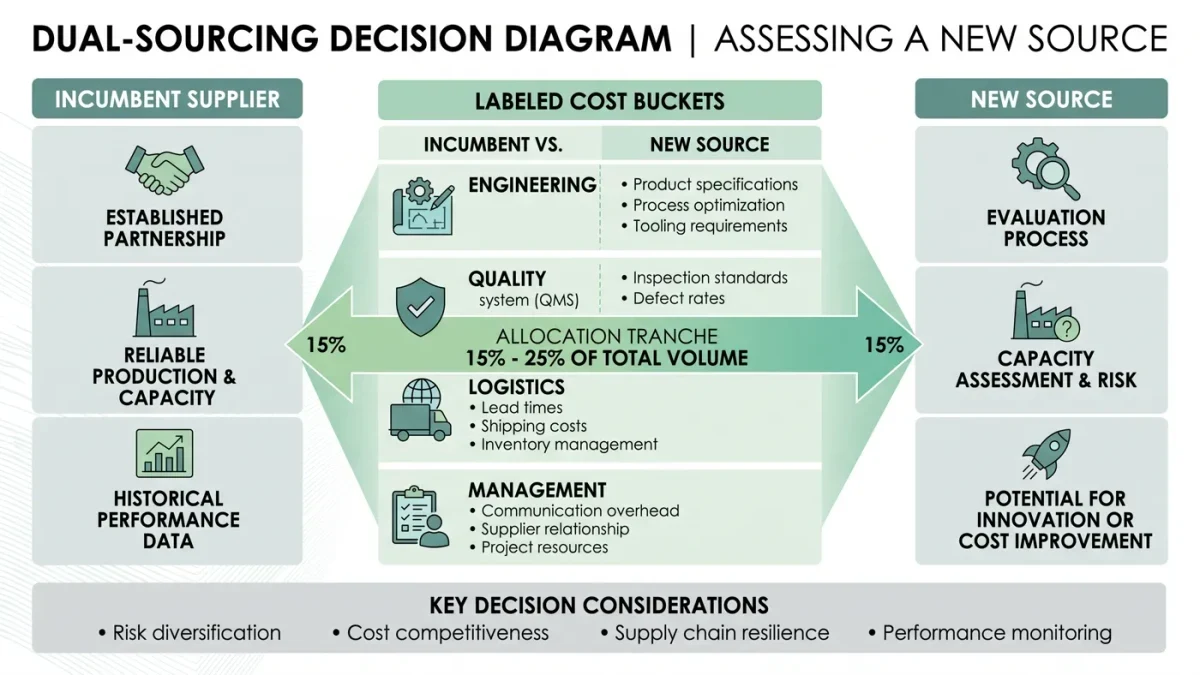
Four buckets, each billable. Engineering: the new supplier must replicate tooling and process — molds, fixtures, test equipment — often duplicating capital the incumbent owns, with first-article inspection and production part approval cycles measured in months. Quality: a new source ships variance the old one had engineered out; incoming inspection tightens, scrap rises through the learning curve, and someone absorbs the yield gap. Logistics: a new origin means new lanes, customs profiles, and lead-time buffers — plus the working capital of a longer pipeline. Management: dual sourcing permanently doubles the vendor-management surface — audits, scorecards, forecasting, and the negotiation complexity of splitting volume between suppliers who each want all of it.
How much volume to move first
The practitioners' answer: a tranche, not a token. Moving 15-25% of volume to the second source keeps the incumbent engaged, keeps the new supplier's utilization economical, and proves the relationship under real conditions — because a qualified supplier with zero orders de-qualifies itself through atrophy. The split also preserves negotiating leverage: the credible ability to move the next tranche prices better than the actual moving of it. The failure mode at the other extreme is the vanity second source — qualified, visited, never ordered from — which shows up in a crisis as a phone call to a factory that has real customers and no line for you.
Where do firms source their plus-one?
The map follows the trade data. Vietnam took electronics assembly and furniture; India scaled phones and pharmaceuticals under production-linked incentives; Mexico absorbed automotive, appliance, and machinery work on the USMCA corridor's truck transit; and Chinese suppliers themselves opened plants in Southeast Asia and Mexico — the connector-country pattern, where the plus-one is Chinese-owned capital with a different passport, per trade-flow analyses. That last wrinkle matters for tariff strategy: origin rules determine duty treatment, and substantial-transformation standards judge what the second source actually does, not who owns it.
How does a firm know it worked?
Metrics, not adjectives. Lead-time variance on the dual-sourced SKUs versus single-sourced. Margin variance between the two sources at current duty rates — the hedge's cost measured in points. Recovery time from a disruption drill — the honest test, run by the firms that learned 2020's lesson: simulate a port closure or a plant stoppage and time the switchover. And total landed-cost parity: the second source does not need to match the first's unit price, it needs to match its risk-adjusted landed cost, with the risk premium calculated from actual disruption history rather than optimism.
The honest ledger
Diversification paid off in this cycle for firms that began before 2024 — their second sources were producing when the 2025 escalations hit, and the premium they had been paying converted to option value overnight. Firms that began after each announcement bought the same insurance at rising premiums, into capacity everyone else was also bidding for. The lesson compounds: the cheapest time to qualify a second source is always before the crisis that makes it necessary, and the second-cheapest time is now. The most expensive time is during — which is when most companies start.
News ABC publishes information, not procurement advice.