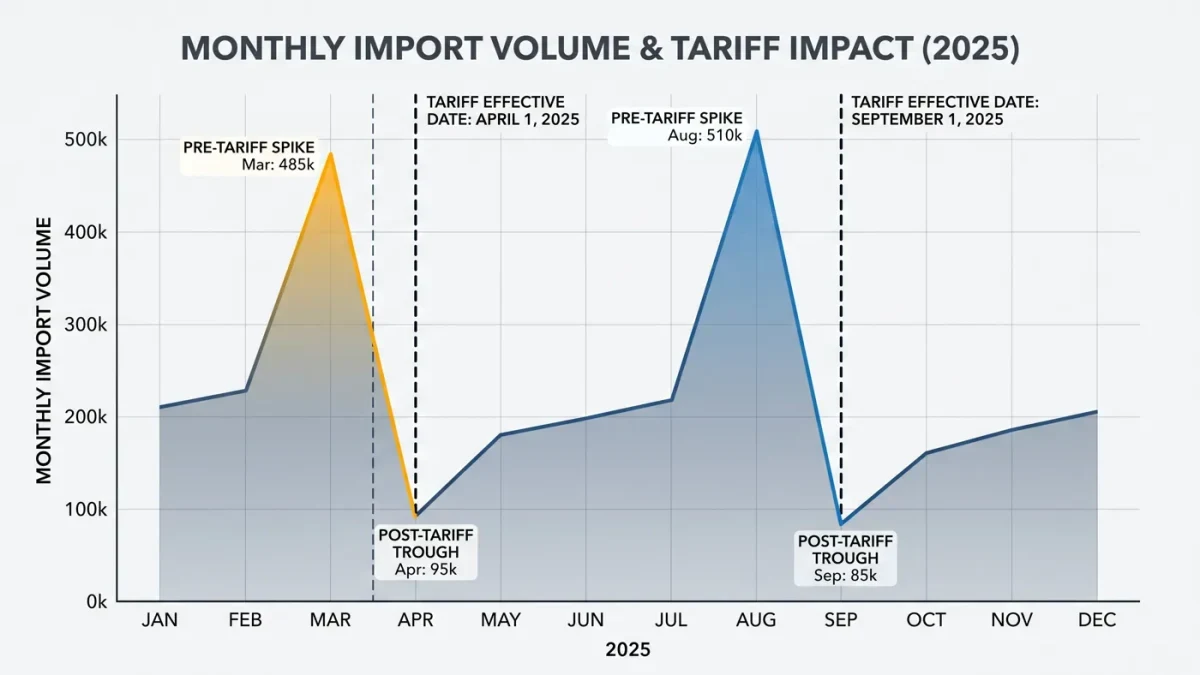
The strangest economic story of 2025 was a race against a calendar. Importers accelerated purchases ahead of announced tariff effective dates — pulling a quarter's demand forward into the weeks before each deadline — and the resulting import surge, inventory swell, and payback dip bent nearly every supply-side statistic that followed. Trade data showed the pattern plainly, GDP quarters swung on import arithmetic, and company earnings calls discussed it by name. Front-running is rational at the firm level and distorting at the macro level, and both facts are worth understanding before reading any 2026 data release.
Why firms do it
Because a dated tariff is an arbitrage window. If duty rises 25% on a known date, inventory bought before the date carries the old rate for its whole shelf life — a return on working capital that beats most alternatives. The calculation scales with rate size, storage cost, and confidence that the tariff actually takes effect. In 2025 the windows were large and repeated: each proclamation's effective date, then the litigation overhang that made even announced tariffs uncertain, then the February 2026 rescission of the IEEPA tariffs after the Supreme Court ruling — which turned the bet around for firms that had front-run goods now overpriced against a zero-rate future.
What it did to the statistics
Three distortions, each mechanical. Trade: import volumes surged before deadlines and slumped after, so monthly deficit figures whipsawed on scheduling rather than demand — the Census data's tell was price-stable volume spikes in exactly the window. GDP: imports subtract from the growth identity, so a front-running quarter posts weak GDP followed by a payback quarter of apparent strength, with domestic demand unchanged — the reason final sales to domestic purchasers is the honest series. Inventories: wholesaler and retailer stocks swelled pre-deadline, then drew down over following months as the front-run goods sold through at old rates, a sequence visible in inventory-to-sales ratios.
How companies manage the aftermath
The post-sprint problem is a balance sheet one: inventory bought at the old rate is now a hedge that must sell through before the duty-priced replacement arrives. Retailers managed it with promotion timing — clearing front-run stock before repricing shelves — and with order-gap planning, deliberately slowing reorders so the drawdown lands smoothly. Manufacturers with input stockpiles ran the same logic on raw materials, with the added wrinkle that excess stock of tariffed inputs becomes a liability if rates fall — the position several firms found themselves in after February 2026, holding inventory priced against tariffs that no longer existed.
What it did to logistics
Compressed the calendar into congestion. Pre-deadline surges filled vessels and warehouses on the trans-Pacific and Latin corridors — freight rates and delivery reliability moved with the tariff calendar more than the retail one. The July 2026 announcement of 50% tariffs on Canadian goods effective August 2026 re-ran the pattern on a new lane, per trade coverage of the run-up, and any future proclamation with a delayed effective date will re-run it again. For logistics operators, tariff calendars became a planning input alongside holiday peaks — a structural change in how capacity is priced.
How to read data through the distortion
Overlay the tariff calendar on any 2025-2026 supply-side series before interpreting it: import volumes against effective dates, inventories against the same, GDP quarters against the import swings inside them. Where the series moved with the calendar, treat it as scheduling; where it moved independent of the calendar, treat it as demand. The discipline matters because the policy schedule has not settled — every future proclamation with a lag between announcement and effective date manufactures the next sprint, and the next bend in the data.