When a tariff lands at the border, the importer of record writes the check — but that is where the question begins, not where it ends. Importers raise prices, squeeze suppliers, absorb margins, or switch sources, and the mix decides whether a tariff is paid by foreign exporters, domestic firms, or shoppers. Two decades of pass-through research, sharpened by the 2018-2019 tariff episodes, give a consistent answer: mostly, the cost lands in the United States.
Who is the legal payer?
The importer of record — the entity that enters the goods with Customs and Border Protection — owes the duty at entry, calculated on customs value plus, where applicable, freight and insurance. That may be a US retailer, a US manufacturer buying inputs, or the American arm of a foreign company. The exporting country's government never pays; that framing confuses tariffs with taxes a foreign treasury collects. Importers may post a bond instead of cash in some entry types, but the liability is theirs.
What does pass-through mean?
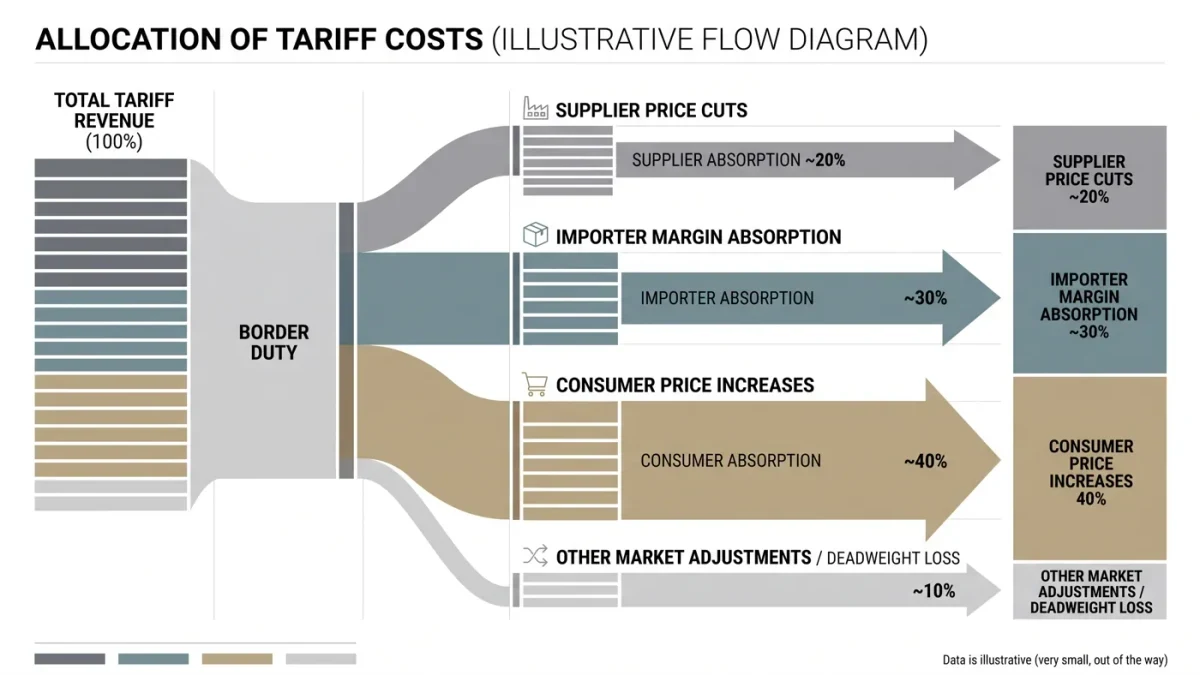
Pass-through is the share of a tariff that shows up in the prices buyers pay. If a 10% tariff becomes a 10% price increase, pass-through is complete; if prices do not move, the importer or exporter absorbed it. Studies of the 2018-2019 tariffs — by Federal Reserve and academic economists using product-level import data — found near-complete pass-through to US import prices at the border, with limited evidence that foreign exporters cut their prices to hold market share. Downstream, retail pass-through was slower and partial, arriving over quarters as contracts reset and inventories turned, but the direction was the same.
Why can't exporters just pay instead?
Because price cuts require margin to cut and market power to hold. Commodity-grade suppliers in competitive markets cannot discount below cost to keep a customer, and concentrated suppliers with unique products have no incentive to. Currency moves can offset some of a tariff — a weaker exporting currency lowers the dollar price — but the research finds that channel absorbed only a modest share historically. The exporter-pays story survives politically because it is simple, not because the data support it.
How do firms actually distribute the hit?
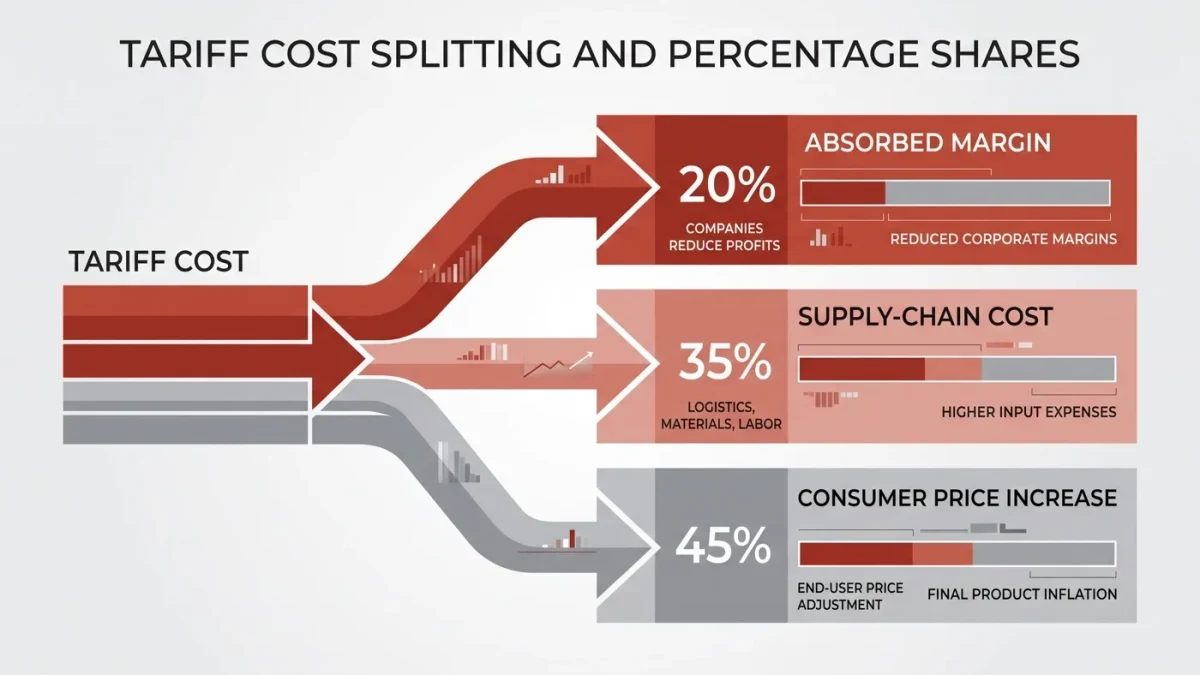
Four channels, usually in sequence. Repricing to customers comes first where contracts allow. Supplier renegotiation follows — importers ask origin factories for cost-downs, and some shift volumes across countries of origin to escape a specific tariff's coverage. Margin absorption runs in parallel, showing up in earnings as gross-compression commentary. And substitution — reformulating products, redesigning around covered components, or re-sourcing — is the long channel that trade data capture a year or more later. The 2025-2026 episodes added a twist: when the Supreme Court invalidated IEEPA tariffs in February 2026 and they were rescinded, firms that had absorbed rather than passed the costs had bet correctly, while those that raised prices faced giving the money back in reverse-price conversations — an asymmetry procurement teams now model explicitly.
What determines how much reaches consumers?
Competition and substitutability. Products with domestic alternatives or multiple foreign sources see softer consumer pass-through because buyers switch; unique, hard-to-substitute goods pass through nearly fully. Retail structure matters: fragmented retail passes cost through faster than consolidated retail that can spread hits across categories. Timing is contract length — spot markets adjust in weeks, annual negotiations at renewal. This is why tariff consumer-price effects arrive gradually and unevenly across product lines rather than as a single visible jump.
How should a small importer respond?
Know your Harmonized System classifications — duty follows the classification, and misclassification is both costly and penalized. Model landed cost at current and zero rates, since the 2026 legal environment proved rates can move both ways. Keep origin documentation clean, because preferential treatment claims rise or fall on it. And when a tariff changes, recompute before repricing: the ladder-style rate tables of 2026 mean product-level differences, not blanket assumptions.
News ABC publishes information, not tax or customs advice.