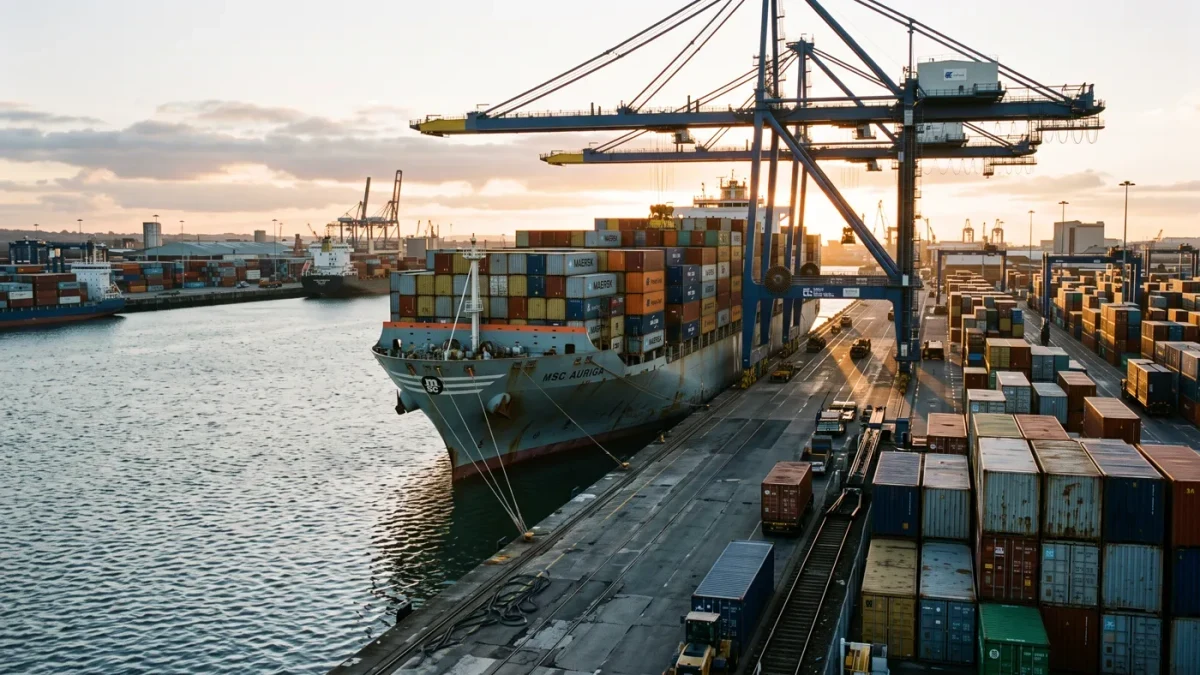
The newest tariff does not apply to cargo — it applies to ships. Fees on Chinese-built and Chinese-operated vessels calling at US ports, initiated under a Section 301 investigation into China's maritime dominance, began phasing in from October 2025 under the Office of the US Trade Representative's action. The fees are charged per port call or per voyage depending on carrier characteristics, they compound across a carrier's fleet exposure, and they are quietly redrawing routes, fleet plans, and freight costs.
How do the fees work?
The structure targets three groups: operators of Chinese-built vessels, Chinese vessel operators, and — on a later phase-in — owners of vessels ordered from Chinese shipyards while taking delivery of US-built tonnage credits. Fees accrue per US port call, with caps and stacking rules that USTR adjusted after the comment process to blunt single-carrier concentration. Carriers respond the way any firm facing a per-unit cost does: they re-route, re-fleet, and re-price. A carrier can minimize US port calls by consolidating cargo at fewer terminals, rotating Chinese-built tonnage off trans-Pacific strings, and ordering replacement ships from Korean and Japanese yards — the order books show the shift already, per shipbroker fleet reports.
What does it do to freight costs?
Spreads them unevenly. Carriers with clean fleets pass through little; carriers with heavy Chinese-built exposure either re-fleet at capital cost or pay and surcharge. The visible symptom is route rationalization — fewer, larger port calls and lower sailing frequency on secondary US ports, which lengthens inland drayage and shifts cost to shippers in markets that lose direct calls. Ocean-freight rates on trans-Pacific lanes absorbed the fee as one more cost item among fuel and canal constraints, per carrier commentary in quarterly filings.
What is the policy trying to do?
Rebuild a domestic maritime industrial base. China builds roughly half the world's commercial tonnage; the US commercial shipbuilding share rounds to zero — the gap the Section 301 investigation documented. The fees function as a demand-side subsidy for non-Chinese yards and, through the US-build credit mechanics, an attempted demand floor for US ones. The honest constraint is time and capacity: Korean and Japanese yards are booked years out, US yards lack commercial scale, and any transition measured in decades cannot be outrun by a fee schedule. Supporters answer that every industrial policy starts as a wedge, not a wall.
Who should be watching?
Three audiences. Importers and exporters with exposure to secondary ports — watch your carrier's port rotations, because a dropped call is a real cost your supply chain absorbs. Carriers and lessors — the fee interacts with flag, build origin, and ownership in ways that make fleet mix a tax-planning question. And anyone in US coastal industrial real estate or shipyard-adjacent manufacturing: the money the fee schedule steers toward domestic construction, including the revenue side dedicated to shipbuilding investment, is the largest maritime industrial program since the merchant-marine era, and its grants and contracts are being allocated now.
What comes next?
The phase-in schedule steps up over time, and trading-partner responses — legal challenges at the WTO and bilateral pressure from carriers' home governments — are running in parallel, so the fee levels are policy, not physics. The durable read is the same one tariff watchers learned in 2026: the document that matters is the annex, and the fleet list is the annex. Carriers publish fleet details; cross-referencing them against port rotations is how the market is pricing what the press releases do not say.