Most tariffs on most products come from petitions, not proclamations. Antidumping and countervailing duty cases — filed by domestic industries against imports they allege are sold below fair value or subsidized by foreign governments — run through Commerce and the International Trade Commission on a schedule fixed by statute, usually ending in duties within about a year. The process is public, documented, and participatory: importers, foreign exporters, and downstream buyers all have standing to argue. Knowing the clock is competitive knowledge.
What triggers a case?
A petition from a domestic industry — a producer, a group of producers, or a union — describing the imported product, the countries involved, and the alleged dumping or subsidization. Commerce reviews the petition for adequacy within 20 days and initiates or rejects; the ITC conducts a preliminary injury vote on a parallel track, asking whether there is a reasonable indication the domestic industry is materially injured by the imports. If both clear, the case proceeds to the full investigation.
What is dumping, exactly?
Dumping means selling in the US market below normal value — typically the price or cost in the exporter's home market, or a constructed cost-plus benchmark. Commerce compares export prices to normal value and calculates a dumping margin as a percentage. Countervailing cases instead measure foreign government subsidies conferring a benefit. Both are ordinary-price concepts applied with heavy documentation: respondents' cost ledgers, home-market invoices, and allocation methodologies are audited by Commerce, and refusal to cooperate results in adverse facts available — rates built from the petition's worst-case numbers.
What is the statutory clock?
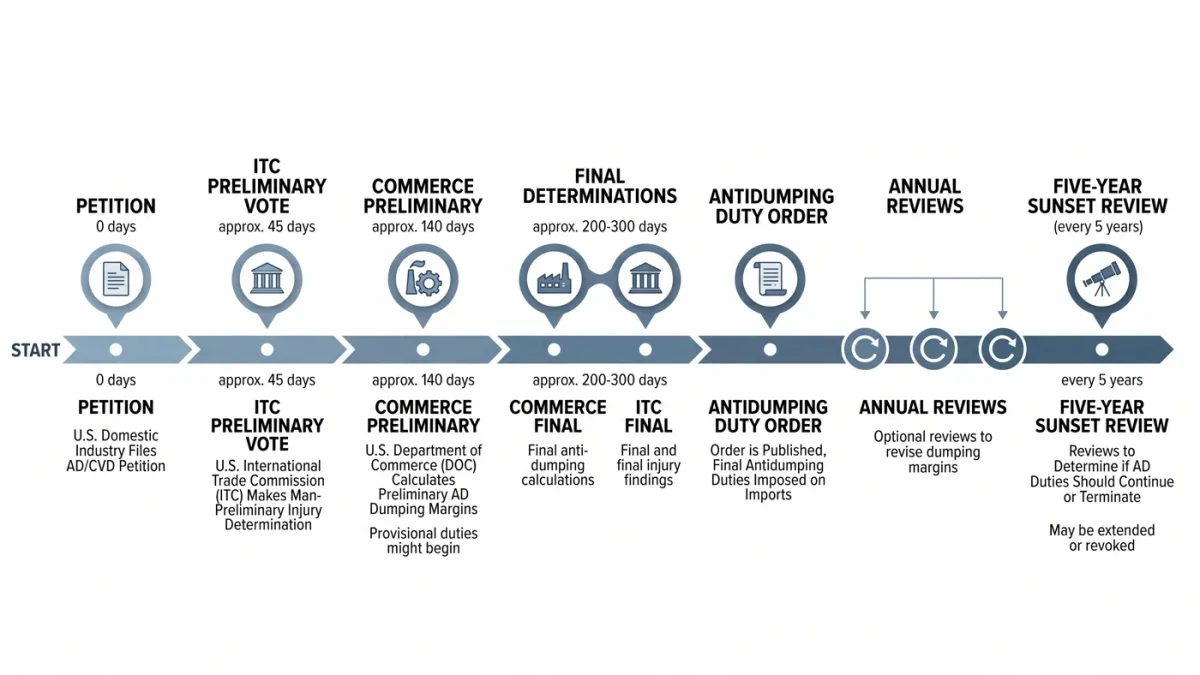
From initiation: the ITC preliminary injury vote within 45 days; Commerce's preliminary determination around 140 days for antidumping (extendable to 190); critical-circumstances findings can apply duties retroactively 90 days from the preliminary; Commerce's final determination about 75 days later; the ITC final injury vote 45 days after that. If the ITC finds injury, Commerce issues an order and duties are collected at the calculated rates — with importers posting cash deposits at entry from the order date. The whole run typically completes within 12 to 18 months.
What happens after an order issues?
Three things. First, administrative reviews: annual proceedings where Commerce recalculates actual rates for entries made during the review year, producing assessments or refunds. Second, new-shipper reviews and scope rulings — newcomers and edge products join or exit the order. Third, sunset reviews every five years, where the ITC revokes the order unless domestic parties show it would likely lead to continued injury. Orders therefore are not permanent, but they persist — many from the early 2000s still stand.
How can importers and buyers participate?
Importers are respondents in their own right for duty rates; participating in the investigation as a mandatory or voluntary respondent secures a company-specific rate instead of the country-wide residual. Downstream users can file comments on scope and testify at ITC hearings, arguing injury or public interest — with less success historically but real influence on product coverage. The practical stakes are large: antidumping rates can exceed 100%, they apply per company and country, and they survive changes in tariff policy — the February 2026 IEEPA ruling and the 2026 Section 232 restructuring did not touch trade-remedy orders at all, which is why petition filings continued rising through the turbulence.
Why does this matter now?
Because trade-remedy cases have become the reliable tariff channel: statutory, court-tested, insulated from the legal challenges that hit emergency authorities. For domestic producers they are protection with a paper trail; for importers they are a due-diligence item — a product that looks cheap may simply be under an order nobody checked. The public docket at Commerce's Enforcement and Compliance unit lists every case, initiation to sunset, and it updates faster than any summary you will read elsewhere.